
Identification number: LZP-2024/1-0078
Type: Latvian Council of Science Fundamental and Applied Research project
Duration: 01.01.2025. - 31.12.2027.
Project Leader: Dr. phys. Mārtiņš Rutkis, Institute of Solid State Physics University of Latvia (ISSP UL)
Responsible person from ISSP UL: Dr. phys. Mārtiņš Rutkis, ISSP UL
Project partners: Riga Technical University, Dr. Kaspars Traskovskis
Total funding: 299 994 EUR
ISSP UL funding: 179 042 EUR
Project summary:
The project aims to develop new organic glasses, specifically glass-forming optical materials, for third order nonlinear optical (NLO) applications such as All-Optical Switching (AOS), Four Wave Mixing (FWM), Supercontinuum Comb Generation (SCG), Kerr Comb Generation (KCG), Optical Power Limiting (OPL), and to assess their potential use in practical devices. The project's objectives will be met by: (i) utilizing quantum chemical modelling (QCM) to propose new structures for organic dyes; (ii) conducting the synthesis of the most promising compounds; (iii) examining their linear and third order NLO properties; (iv) evaluating the feasibility of incorporating newly developed materials in photonic devices through numerical modelling. These activities will provide insights into the structure-property relationships in organic third order NLO materials and create new organic optical materials suitable for practical use as third order NLO active media. The project aligns with the research priorities of the Institute of Solid State Physics (ISSP) concerning the further development of "Third order non-linear optical effects, materials, and devices." It also supports the RIS3 priority area of "Smart materials, technology, and engineering" in Latvia as outlined in the “European Commission, Smart Specialisation Platform Latvia (LV)”.
PROJECT PROGRESS
1-3: The project has been launched! The project teams have begun their first work on the synthesis of new organic materials intended both for third-order nonlinear optical applications, such as frequency comb generation and the development of optical switches, and for the development of optical limiters. In parallel, the first COMSOL models have also been initiated to enable simulations of the practical applicability of the materials under investigation.
4-6: The project’s first small-molecule organic compounds have been successfully synthesized, and work on their characterization can now begin. Material characterization includes recording their absorption spectra and measuring their third-order nonlinear optical properties using the Z-scan technique. This method allows for the simultaneous determination of changes in both the material’s refractive index and optical absorption as a function of optical intensity. These effects are known as the Kerr and two-photon absorption effects.
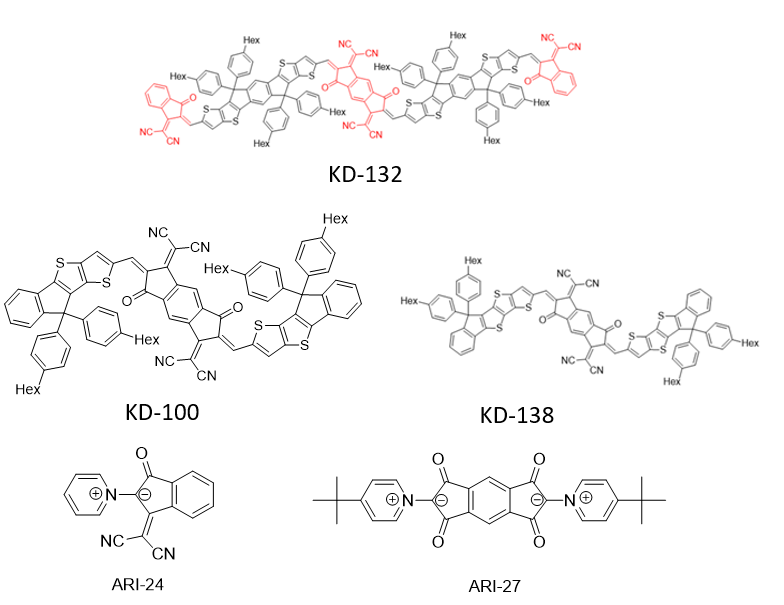
7-9: The key to achieving good results is effective communication between team members. The first results obtained from the synthesized compounds are promising, with the materials reaching Kerr coefficient values of 10–13 cm²/W, indicating good potential for practical applications. At the same time, it was found that these compounds are soluble in solvents only at low concentrations, which limits their practical applicability. Discussions with our chemistry colleagues have already led to new ideas for modifying the compounds in order to obtain materials with improved solubility. This is essential for practical applications, as host–guest systems need to be developed in which the organic dye is dissolved together with a polymer. Such inks can then be printed using an inkjet printer to create localized photonic elements on chips, which is a key technology for heterogeneous integration.
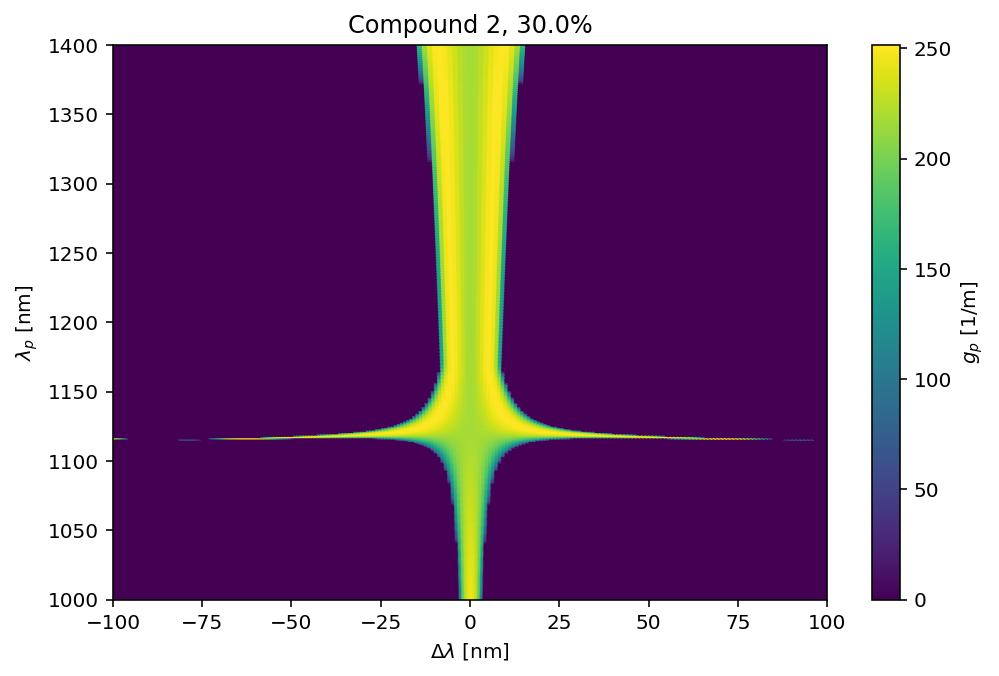
10-12: The synthesis of organic materials and the fabrication of photonic chips are time-consuming processes, which can take more than six months from the initial idea to the final result. Given the number of materials being investigated in the project, experimentally testing the practical applicability of every compound would require a considerable amount of time. This is where simulation models can be highly beneficial: using only information about the optical properties of the materials, they can assess their potential for practical applications. This reduces the time required for the material selection process severalfold. Within this project, we are simulating waveguide systems for optical limiting, frequency generation, and other photonic applications. These simulations have enabled us to obtain the spectral distribution for frequency generation.
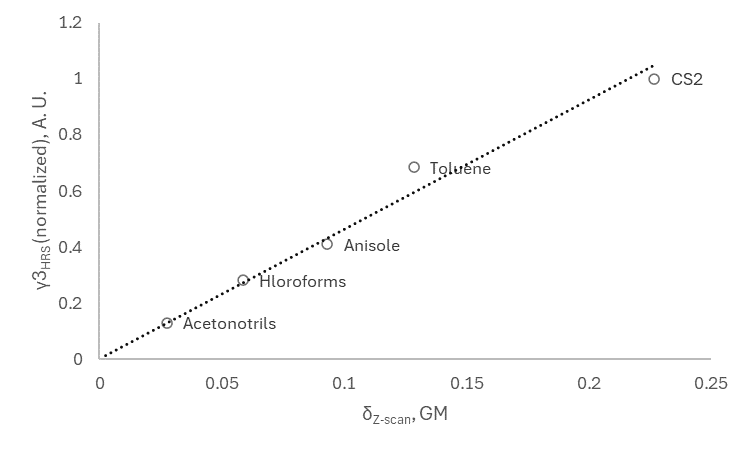
13-15: To identify the best materials for practical applications, a reliable characterization methodology is essential. With this in mind, our project team set out to compare two methods for measuring third-order nonlinear optical effects: the Z-scan and third-order hyper-Rayleigh scattering methods. While the Z-scan technique has already become a standard benchmark for studying Kerr and two-photon absorption effects, the third-order hyper-Rayleigh scattering method is less extensively studied. For this reason, it is important to compare it with well-established methods before using it more widely. Our ongoing studies have shown very good agreement between the two measurement methods when using different solvents.
16-18: To introduce the project’s results to a broader audience, the project team attended the SPIE Photonics Europe conference, where they presented two poster contributions: “Second Hyperpolarizability Measurements of Organic Materials by Third Harmonic Hyper-Rayleigh Scattering” and “Assessment of Polymer Host–Guest Materials for All-Optical Photonic Applications by COMSOL Simulation.” During the conference, the team also had the opportunity to discuss the potential applications of organic materials in photonics with other international researchers. During this period, two conference papers on these topics were also published.