
Recently, the Latvian medtech startup Cellbox Labs – which originated as a deep-tech spin-off rooted in the research of the Institute of Solid State Physics, University of Latvia and the Latvian Biomedical Research and Study Centre – was featured in Latvian media.
Below is a full English translation of the article detailing their innovative technology, origins, and future plans:
When we have a headache, a cough, a runny nose, a fever, or any other health issue, we are accustomed to going to the pharmacy and purchasing medicine to help our bodies recover. But have you ever wondered how medicine actually makes it to pharmacy shelves?
Developing new drugs is a long and expensive process. From initial laboratory research to the moment medication becomes available to patients in European pharmacies, several years can pass. Information available online suggests this can take anywhere from 10 to 15 years. In some cases, the process is shorter, but the development of other drugs can take even longer.
Although society is often accustomed to complaining about how bad everything is in healthcare and how difficult it is to start new businesses in Latvia, there are people who succeed despite the challenges. Among them are the founders of the startup Cellbox Labs – Gatis Mozoļevskis, Roberts Rimša, and Artūrs Ābols.
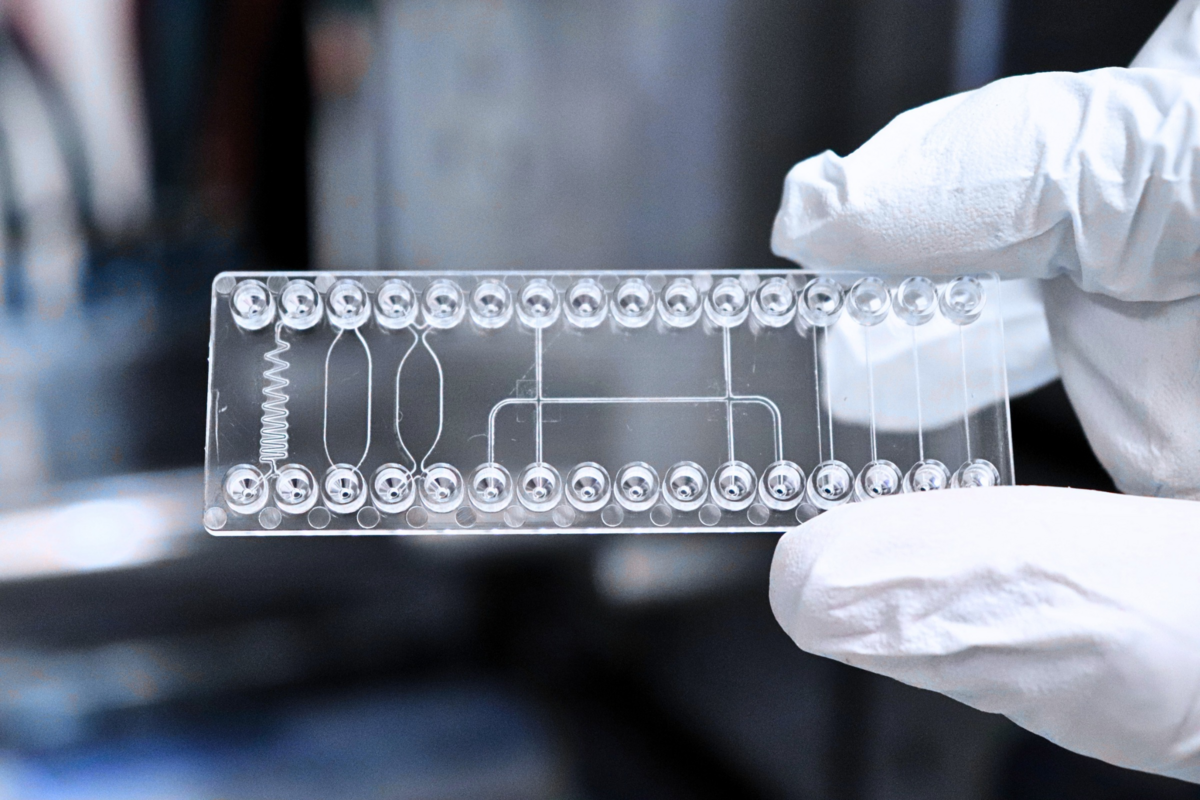
Gatis, the company’s CEO and co-founder, shared more about Cellbox Labs in an interview. Founded in 2020, the company focuses on organ-on-a-chip technology. Explained in simple terms, they develop disposable chips into which various human organ cells are introduced. These chips are then placed into a custom-built device designed by the team, which closely simulates the human physiological environment, transforming the cells into small tissue blocks. "It mimics the behavior of our organ," Gatis explains.
You might ask: why is this necessary, and what does it have to do with the aforementioned diseases and drug usage? The technology developed by the company helps solve two major problems – the lengthy duration and high costs of drug testing, which can run into billions. Faster and more efficient drug testing would save massive financial resources, which would likely result in cheaper medications at pharmacies as well.
The "organ-on-a-chip" technology allows researchers to more precisely determine the efficacy and toxicity of medication using specific human organ models. Furthermore, following the traditional route of testing drugs on animals and humans, only 1 out of 10 drugs actually works in humans, Gatis points out. 90% of drugs are either ineffective or toxic.
"It’s similar to comparing it with skin. If we wanted to know if we are allergic to a certain product, it would be enough to apply that product to one spot on our skin and observe. We wouldn't need to smear ourselves head to toe to figure out whether we have an allergy or not," the co-founder compares.
Currently, the company is in an early stage, and its clients are primarily research laboratories, universities, and institutes, while drug developers, pharmaceutical companies, and biotechnology firms represent Cellbox Labs' target market.
Currently, the company's focus is on the gut, where cells placed within the organ-on-a-chip technology allow for the study of the microbiome as well. For example, Cellbox Labs is currently collaborating with a company in Switzerland to study the efficacy of their prebiotics. This makes it possible to investigate the effectiveness not only of pharmaceuticals, but also of dietary supplements. "The goal of this prebiotic is for people who are pre-diabetic – they have a chance of developing diabetes in the future. They would then use this prebiotic to reduce the likelihood of developing diabetes," Gatis shares.
Although testing for various purposes is carried out using the organ-on-a-chip technology, the company's main commercial focus remains on selling the hardware equipment and disposable chips.
Gatis shares that the creation of the company happened quite organically, as it served as a bridge between two scientific institutions: the Latvian Biomedical Research and Study Centre (where co-founder Artūrs Ābols worked) and the Institute of Solid State Physics, University of Latvia, where Gatis was based.
"There we had all the necessary infrastructure, modern cleanrooms, and various analytical methods. Therefore, it was a very organic choice to build the company right here in Latvia, as for the first few years we did this alongside our academic careers, and then in 2024 we began working in the startup full-time," the entrepreneur recounts.
Currently, the company employs 18 people: three co-founders, each an expert in their respective field, eight engineers who design and develop the equipment and chips, five specialists working in biology, and two handling project management and administration.
Given that Cellbox Labs is fundamentally a hardware company, they manufacture and develop their equipment right here in Latvia. "Because of that, in Latvia, I think it’s not easy, but it is possible to find top-class specialists – mechanical engineers, electronics engineers, programmers – to develop such technologies. Biologists are definitely fewer in number; finding biology specialists is a greater challenge, which is why we also have a colleague from Germany who moved to Latvia. Now we are actively looking for biologists specifically for the company," Gatis says regarding the experience of building such a business in Latvia.
"Regarding the vision, I would say that compared to many places in Europe, everything here is very digital, and everything can be done remotely, which is a major plus. We founded the company in 2020 during Covid, so I think I haven't even visited a single government institution in person yet," the entrepreneur recalls.
He also acknowledges that Latvia is a small country, making everyone easier to reach. He praises the strong support provided by the Investment and Development Agency of Latvia (LIAA) and the Ministry of Foreign Affairs across various countries. The convenience of Riga International Airport in facilitating easy travel to different destinations is also highly appreciated.
Discussing the downsides, Gatis expresses some frustration regarding Latvia's small deep-tech ecosystem – there are few such companies and few local investors. "Therefore, naturally, we would love for this ecosystem to be larger, so that suppliers were right here on-site, because right now our supply chains stretch from Europe, the US, and Asia," says Gatis. Additionally, since there are no major pharmaceutical or biotechnology corporations in Latvia developing products locally, the company was forced to target the international market from day one. All of Cellbox Labs' clients are located abroad.
Raising capital was also a challenge – in fact, it was the hardest part of the entire process. The majority (80%) of total funding, exceeding 6 million euros, consists of various Latvian and European grants (financial support awarded to a company, researcher, or organization to achieve a specific goal, which generally does not need to be repaid if conditions are met). The remaining 20% was raised from private investors.
This year, the company's focus has been on active commercial operations, delivering equipment to clients, but the overarching goal is to stabilize and secure more clients within the pharmaceutical sector.
"One of the steps is to perform validation of these testing models. This means we take a 'gut-on-a-chip,' test it with, say, seven drugs that have a very well-known and proven effect in humans, and then demonstrate that the effect inside our chips is identical to what happens in humans. That way, we can confidently claim that these chips can be used for drug testing. Consequently, validation is a crucial step for us to more easily market and sell this technology to pharmaceutical companies," Gatis explains.
Following the achievement of this milestone, the next step would be the development of other organ-on-a-chip models. The next organ in line would be the blood-brain barrier in human brains, followed by lungs, the liver, and kidneys. The company has already developed a cancer-on-a-chip technology, with ambitions to continue expansion into oncology.
Concurrently, the team aims to further advance their equipment by integrating microscopy and various sensors to generate real-time data. This will make it possible not only to measure flow rates within the chips but also to monitor oxygen concentrations, pH level changes, or organ barrier permeability.
These measurements will help develop algorithms allowing the device to automatically adjust parameters for each personalized chip, thereby yielding the most precise data possible. "We see this as a step that no one has achieved yet. It will significantly enhance the practical application of the technology," the entrepreneur acknowledges.
Looking toward the distant future, the ultimate goal is personalized medicine, where a patient could donate a blood sample, extract cells from it, and differentiate them into various organ-specific cell types. This would enable doctors to determine precisely which medications and dosages are best suited for a specific patient, as well as identify potential side effects – including finding the most effective chemotherapy drugs.
On average, developing the technology for a new organ takes the company approximately 15 months.
