
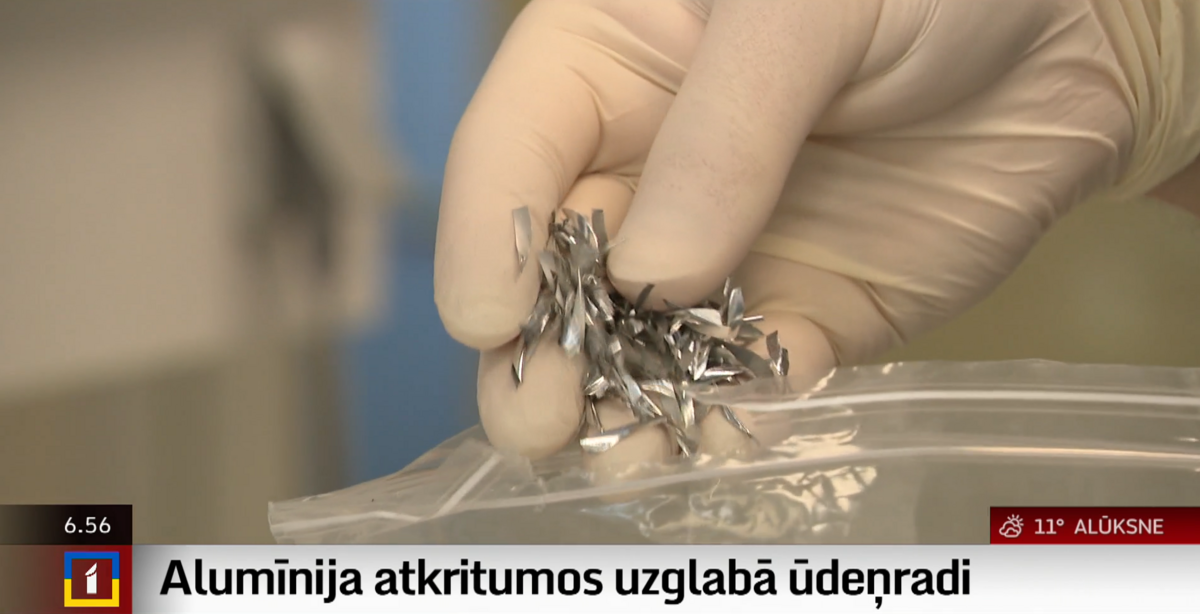
A recent TV news broadcast highlighted the groundbreaking work of scientists at the Institute of Solid State Physics, University of Latvia (ISSP UL). The segment showcased their innovative solution to one of the green energy sector's biggest challenges: hydrogen storage and transportation. By utilizing aluminum waste, the researchers are helping to create a localized, energy-positive circular economy that transforms everyday waste into a valuable energy resource.
Hydrogen is widely considered a key solution for future energy needs. However, its broader application is currently hindered by expensive production, as well as complex storage and transportation requirements that typically demand highly specialized tanks. ISSP UL scientists are addressing these hurdles head-on by developing a method to store and transport hydrogen within a material derived from recycled aluminum.
ISSP UL is constantly exploring alternative methods for hydrogen production and storage. During the broadcast, ISSP UL Leading Researcher Ainārs Knoks showcased how hydrogen can be stored in what appears to be a simple metal coin. "Such a coin holds 60 watt-hours of energy," Knoks explained. "We cannot squeeze that much energy into such a small volume using lithium batteries or conventional fuel."
While the specific coin demonstrated was not manufactured in Latvia, ISSP UL scientists – in collaboration with colleagues from Lithuania and Iceland – are developing a similar method that utilizes discarded aluminum, giving the waste a second life. This effort directly ties into the institute's broader research, such as the AliCE-WHy project, where ISSP UL has been designing prototype devices to transform aluminum waste into hydrogen energy.
The core advantage of this method lies in its efficiency and simplicity. "Aluminum is easy to transport, and we know how to obtain and recover it. Under certain conditions, through a reaction with water and a few chemicals, we can split water and produce hydrogen without any additional external energy," Knoks noted. "Roughly calculating, for every gram of aluminum, we can obtain about a liter of hydrogen. This significantly eases both transportation and storage."
In the news segment, laboratory assistant Raitis Sika demonstrated the practical application of this research. "We open this very simple reactor, put in the aluminum – in this case, 25 grams – and pour in a liter of alkali. From there, the chemistry does everything on its own," Sika demonstrated. Noting the bubbling reaction, he added, “It looks a bit like carbonated water. That is the hydrogen starting to form in the process.”
Beyond simplifying transport and bypassing the need for expensive storage tanks, incorporating hydrogen into aluminum presents additional environmental benefits. The process can help capture carbon dioxide – a major contributor to global warming – and recovering the hydrogen also generates heat that can be utilized for local heating purposes.
Looking toward the future, Knoks outlined potential everyday applications for this technology. "One possible application would be having a generator at home where you can throw in your aluminum waste. Alternatively, a municipality could have a larger generator to process all local waste and produce the necessary electricity," he shared.
Ultimately, this innovative technological process creates a localized, energy-positive solution that could play a pivotal role in the green energy transition.
