
Behind every colour lies exact science – the arrangement of atoms, molecular bonds, light spectra – and it is precisely at this point, between molecules and colours, that materials science and new innovations develop. In anticipation of Researchers' Night, researchers at the Institute of Solid State Physics, University of Latvia (ISSP UL) share stories about the interaction of colour and science in our daily work and laboratory experiments.
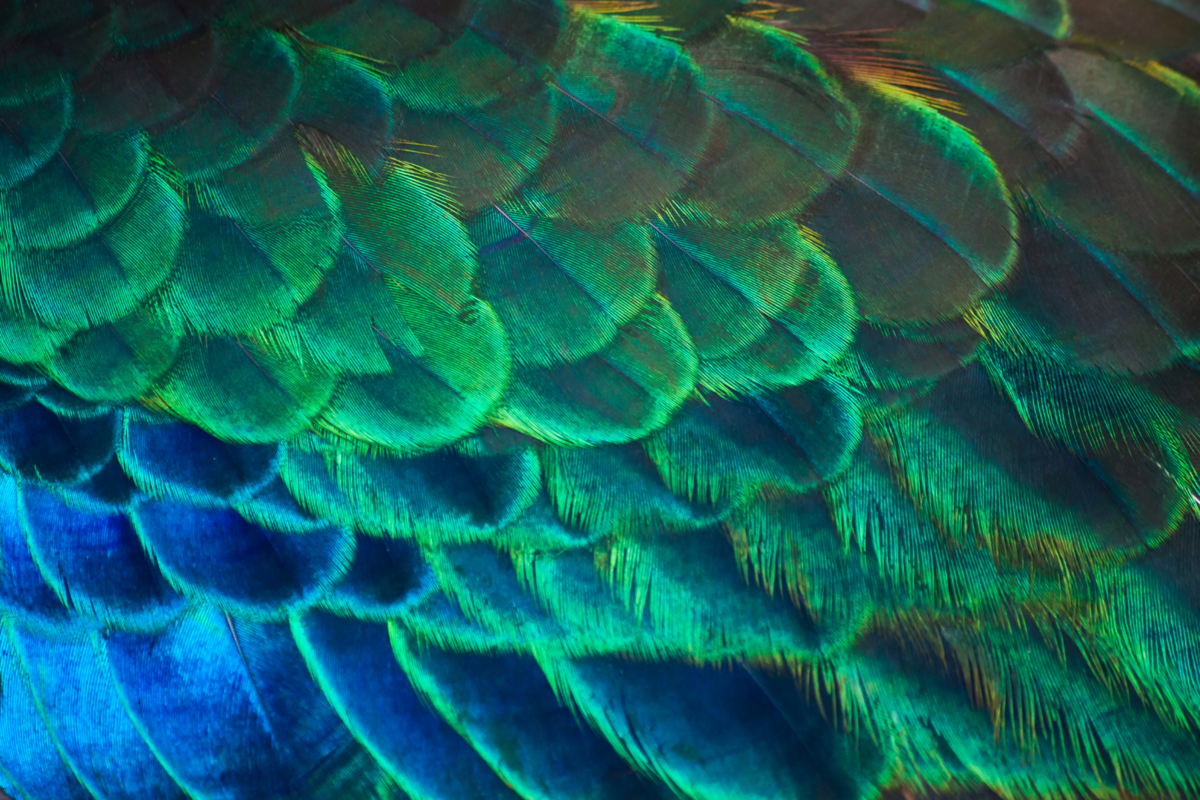
Did you know – if you cut up a peacock feather or a Morpho butterfly wing into tiny pieces, their vibrant colours vanish? That is because their characteristic color is produced not by pigment, but by the way the structure of their wings interacts with light. How these natural structures acquire their iridescent hues is explained by Ēriks Dipāns, research assistant at our Thin Films Laboratory.
“In nature, there are cases where structural colour is used instead of pigment. Looking at those same peacock feathers under a microscope, tiny, layered structures appear to the eye. Thin film upon thin film forms a coating that causes light waves to reflect and interfere with one another, giving the feather its shifting blue-green appearance. It is always interesting to observe how nature and science go hand in hand – the interaction of light with thin films is fundamental to the work in our laboratory,” says Ēriks Dipāns
By depositing material layers on a nanometer scale, ISSP UL researchers create coatings with specific optical properties. For example, in the SWEB project, windows are being developed that automatically darken on hot, sunny summer days, improving building ventilation and energy efficiency. The Thin Films Laboratory also develops a variety of other optical and functional coatings, next-generation optical sensors, and conducts fundamental research into the properties of nanoscale world.
Discover more colourful scientific wonders in the article series Between Molecules and Colors!
