
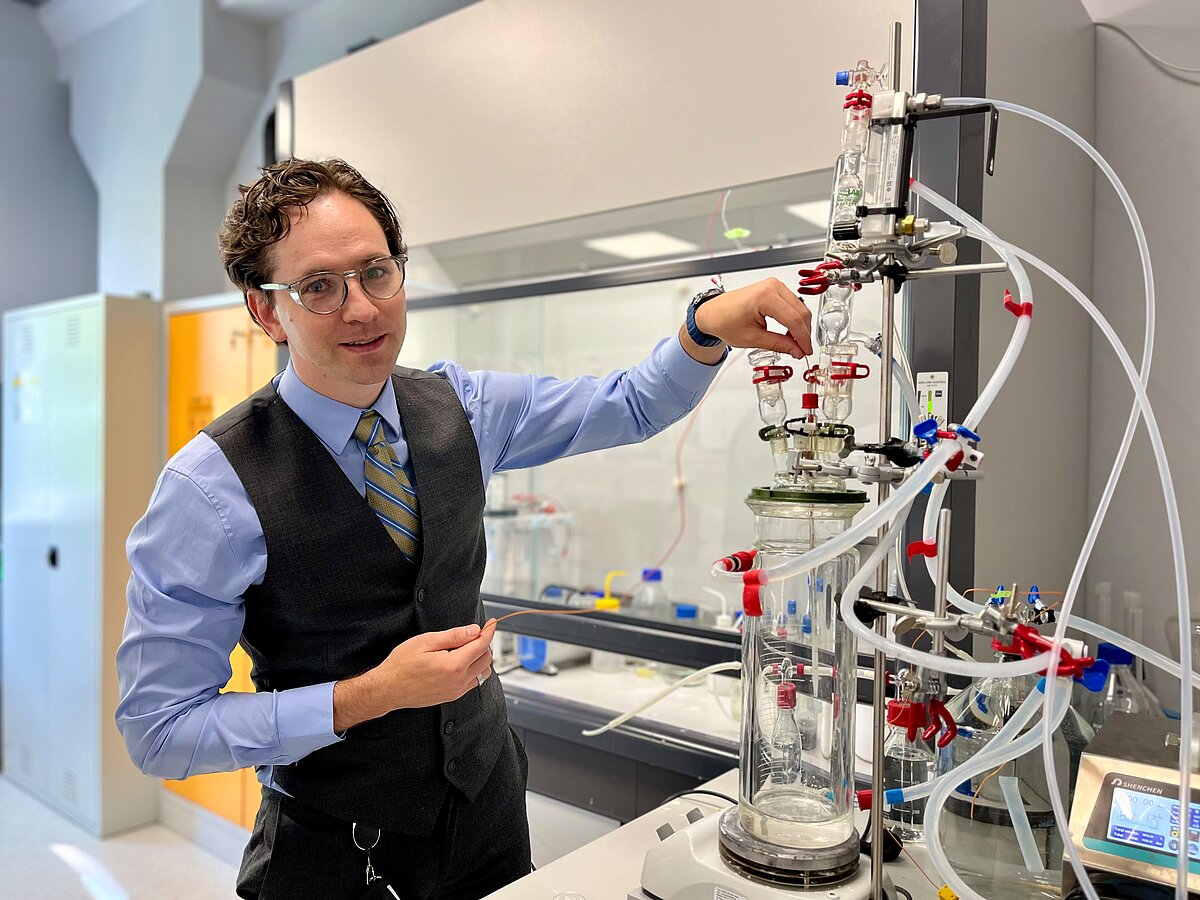
This week, Ainārs Knoks, Leading Researcher at the Energy Materials Laboratory of the Institute of Solid State Physics, University of Latvia (ISSP UL) appeared on Latvian radio show Zināmais nezināmajā (The Known in the Unknown) to introduce listeners to the capture and recycling of atmospheric carbon dioxide.
Around 37 to 40 billion metric tons of carbon dioxide (CO2) are released into the atmosphere annually, compared to under 4 billion tons a century ago. Given the risks and consequences of these CO2 levels, researchers are exploring ways to turn this gas into a useful resource on Earth. Ideas and solutions for CO2 capture and storage abound globally, prompting the show to feature ISSP UL expert Ainārs Knoks, who is involved in several research projects addressing this issue through various experimental methods.
The discussants highlighted the urgency of the matter and explored existing solutions and success stories – such as Iceland, where plans are underway to implement CO2 capture systems, and a US startup developing an electrochemical process to capture CO2 directly at point sources of production.
Ainārs also highlighted the useful role of aluminium waste in capturing and reusing carbon dioxide, which is one of the core research avenues at ISSP UL. He noted that, depending on the method used, the CO2 capture process can simultaneously generate hydrogen and heat, which can be utilized as energy sources in manufacturing or stored for later use.
In the end, the participants agreed that capturing and storing emissions underground is currently the more common short-term approach. However, Ainārs encouraged looking toward a more sustainable future, where such carbonate "rocks" are reinvested into a circular economy and repurposed for fuels, raw materials, and other production processes.
