
Behind every colour lies exact science – the arrangement of atoms, chemical bonds, electronic structure and light spectra – and it is precisely at this point, between molecules and colours, that materials science and new innovations develop. In anticipation of Researchers' Night, researchers at the Institute of Solid State Physics, University of Latvia (ISSP UL) share stories about the interaction of colour and science in our daily work and laboratory experiments.
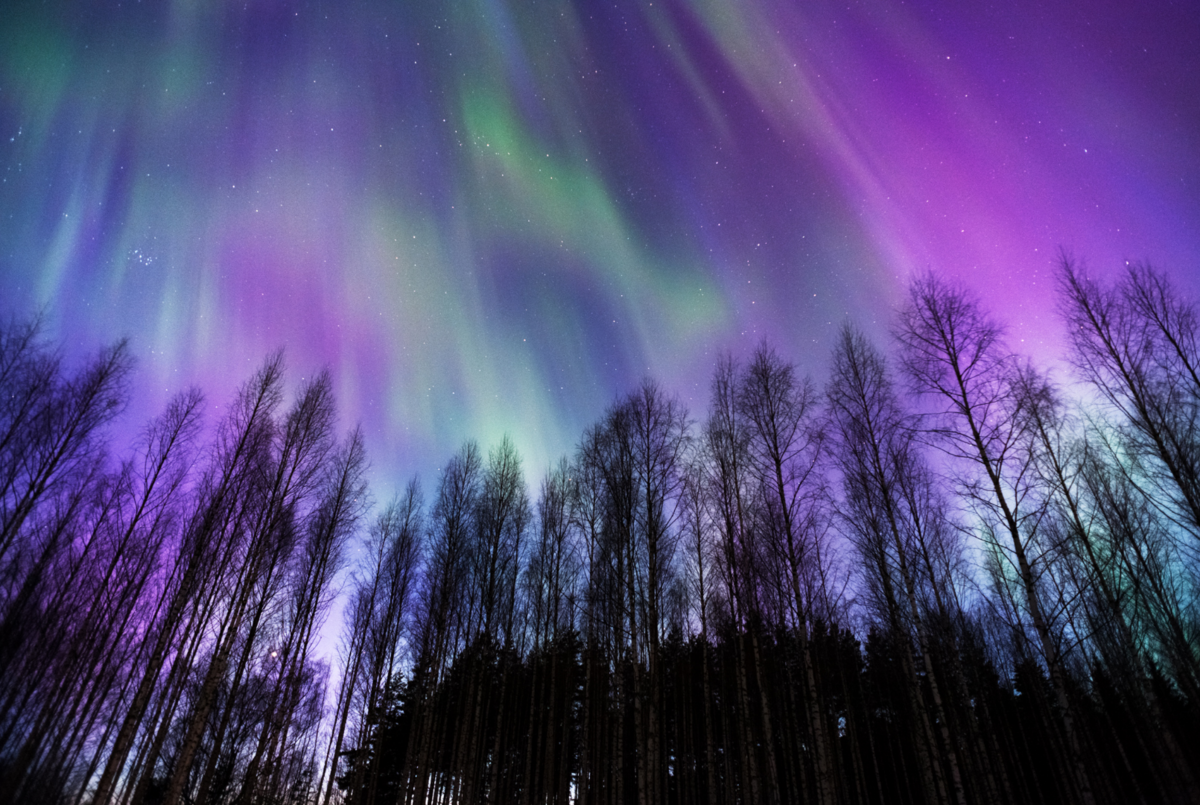
Perhaps you have been lucky enough to catch a sight quite rare in Latvia – Aurora Borealis or the Northern Lights. But what exactly causes the sky to take on these green and purple hues? We asked Virgīnija Vītola, leading researcher at the Optical Materials Laboratory.
“It all starts with the Sun. Charged particles (protons and neutrons) are continuously released from its corona, reaching massive speeds and traveling all the way to Earth – this phenomena is known as solar wind. The Northern Lights occur when these particles meet with the Earth's magnetic field, which 'captures' and redirects them toward the planet's northern and southern poles. There, the solar wind particles collide with atmospheric gases, elevating their electron energy states and exciting the atoms. Upon returning to lower energy states, they release energy in the form of light – a process fundamentally similar to luminescence. The result is a spectacular, planetary-scale light show, but the physics behind it are based on the same principles we study in the Optical Materials Laboratory," explains Virgīnija.
In the laboratory, researchers discover how various solid-state materials absorb and emit light. This research results in new applications for optical materials – for example, the BioPhoT platform's project DARS is working on a long-glowing, luminescent coating for road signs. The laboratory's work also develops new devices such as scintillators and phosphors, which are used in radiation detection, medical imaging, and energy-efficient lighting.
Discover more colourful scientific wonders in the article series Between Molecules and Colors!
