
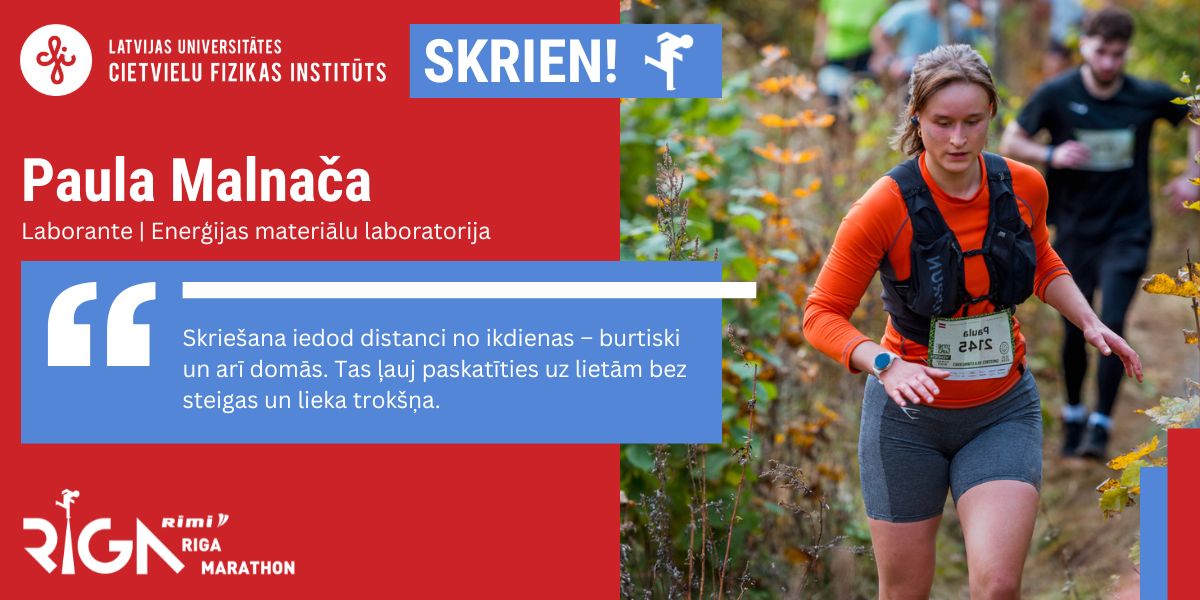
What does it take to run a marathon? Is preparation easier when applying a scientific mindset? This is what we set to find out as the RIMI Riga Marathon nears, since the Institute of Solid State Physics, University of Latvia (ISSP UL) is proud to have multiple researchers competing in the event.
On perseverance both on the forest trail and in the laboratory, and readiness for the first full marathon, we spoke with Paula Malnača, a laboratory assistant at the Energy Materials Laboratory.
How would you briefly describe your scientific field and what do you research?
I work in the Energy Materials Laboratory and study lithium-ion battery cathode coatings that improve their cycling stability and battery longevity.
When and why did you start running? How did you turn to marathons and long distances?
I started running more regularly at the beginning of my bachelor's studies when I needed to find a physical activity that could be done anywhere regardless of the time of day – put on your shoes and you're ready. This was especially important when a busy schedule forced the rescheduling of all existing sports activities. I plan to run the marathon distance for the first time this year, but I have always liked to test the limits of my abilities.
How much time a week do you devote to running? What distance and/or route do you usually run?
Everything, of course, depends on the training phase, but usually I try to run three times a week. I try to include one calmer run every week, one with a slightly faster pace or intervals where I can challenge myself, and then the climax of the week – the long run. That is usually a little adventure running through all of Riga or on forest trails in some Stirnu buks.
Do you see parallels between scientific work and preparing for a marathon? What from marathon discipline helps the most in science?
There are definitely parallels. Both in science and in preparing for a marathon, the most important thing is patience and the ability to accept failures as part of the process. Not everything works the first time – sometimes you have to change the approach, adjust plans and simply continue.
I have experienced this in both areas: in science, when results do not come as quickly as I would like, and in running, when injuries or a busy schedule make me review training or even give up a start. It is precisely perseverance that helps move forward even when conditions are not ideal.
How do you balance training with laboratory work / projects?
This is still a daily challenge because it is filled not only with scientific work but also full-time master's studies and organizing classes for the Young Physicists' School. It's impossible without planning, but I try to find a place for each thing in the schedule.
How does running affect your thinking or productivity in research? Have you had ideas or “aha moments” while running?
Running provides distance from the everyday – literally and also in thoughts. Exactly this distance allows looking at things without haste and unnecessary noise.
Often this does not mean new ideas, but clarity – what is important and what actually just takes up space.
How do you feel in the last 10 km of a marathon? How do you overcome “crises of will” – both in a run and in projects?
I haven't experienced the last 10 km of a marathon yet – hopefully, that will change this year. But there have definitely been difficulties in runs, and the feeling is always similar – at one point you don't want to anymore, but you have to continue.
Everywhere in everyday life, the principle doesn't change – the secret weapon is to divide the big and difficult (be it a run or a to-do list) into smaller parts. Not to think about everything at once, but only about the next step, the next kilometer, the next task. And then somehow everything slowly moves in the right direction.
Does your scientific thinking affect how you train? For example, do you analyze your training data (HR, $VO_{2}max$, pace) or use any specific strategies?
Of course, data analysis is important to understand how the body reacts and how to act next. But sometimes you just want to leave the watch at home and go for a run. There is a part of beauty in that too.
Will you also run in any other event this year (e.g., some Stirnu Buks)?
Yes! For several seasons I have been increasing the Fizmati orange both in Stirnu buks and Noskrien ziemu. These are the events you don't have to think about for long – you just know you want to be there and enjoy the atmosphere.
Which marathon has remained in your memory the most and why?
The marathon is still ahead – hopefully, this year will finally be the first. But from previous experience, the first half-marathon two years ago has remained in my memory the most – that was the moment when I realized that I can do more than it seemed.
And the Stirnu buks stages… they are all close to the heart. Each one different – sometimes harder, sometimes easier, but always with the feeling that you are in the right place.
What would you recommend to a colleague who wants to start running? How to start if time is very limited?
You have to start with a little – even a run around the house or the block counts. The most important thing is not the distance, but the fact itself that you went out, because that is often the more complicated part. If time is limited, then it's even more important not to overcomplicate – put on your shoes and go. When it becomes a habit, the rest starts to arrange itself.
If you listen to music while running, what is your favorite song?
I listen now and then, yes, but I often try to run without music as well. In longer runs, something in the background is useful – Fleetwood Mac has never failed me there.
What is one book you would recommend to others?
Most often a physics book can be found in my hands, but I am quite easily persuaded to any detective story – a good plot and I'm “in.”
What is one habit that changed your life?
The ability even after a long and exhausting working day to put on a sports outfit and just leave the house. I don't always want to, but I almost never regret it.
Your next goal in science or running?
In running, I hope to get through the training period without injuries this year and actually run my first marathon. In scientific work, I hope to write my first publication.
