
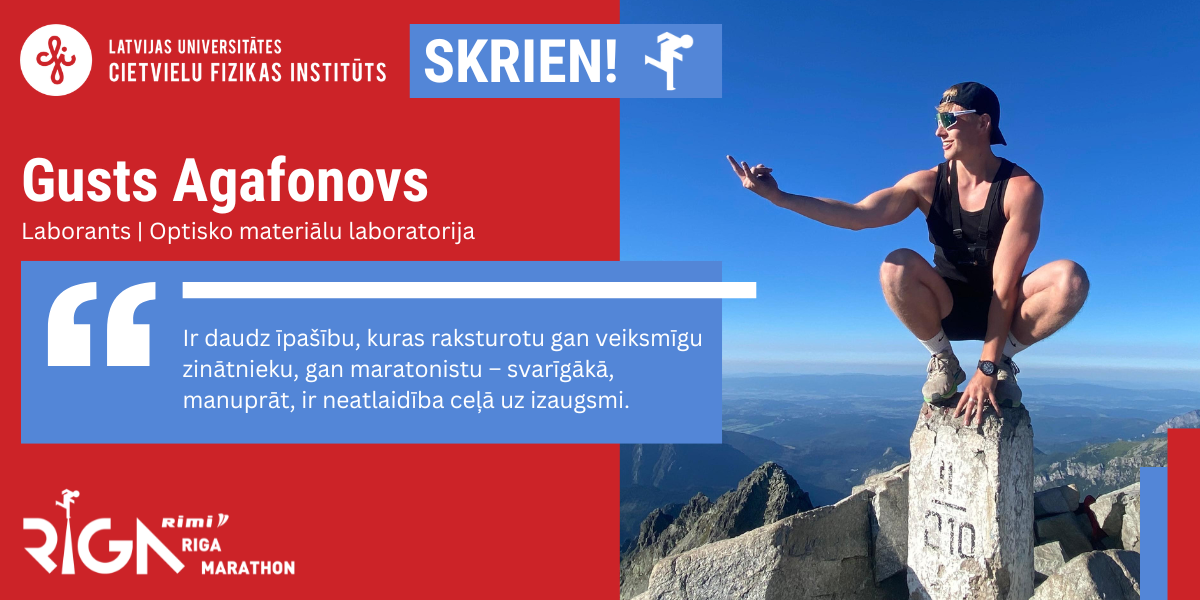
What does it take to run a marathon? Is preparation easier when applying a scientific mindset? This is what we set to find out as the RIMI Riga Marathon nears, since the Institute of Solid State Physics, University of Latvia (ISSP UL) is proud to have multiple researchers competing in the event.
We sat down with Gusts Agofonovs, a lab assistant at the Optical Materials Laboratory, to discuss the internal struggle of a marathon and the state of being in constant motion – both physically and mentally.
How would you briefly describe your scientific field and what you are researching?
I work with materials that "react" to the surrounding world. More specifically, I study lead-free ferroelectric ceramics, analyzing how a sample's microstructure and phase composition determine its functional properties and potential applications.
When and why did you start running? How did you pivot to marathons and long distances?
I started running back in primary school, when the only way to get the tastiest snacks in the canteen was to be the fastest. But I turned to running more seriously as a sport (rather than just a way to get around) at age 14 when I started track and field. Even then, I ran the 3000m simply because I didn't have the speed for sprinting. My parents gifted me with character and endurance, so I turned to a less dynamic but rather long form of self-torture.
How much time do you devote to running per week? What distance or route do you usually run?
I can’t give a specific distance because my plan is quite diverse. Training sessions include interval runs, long and slow runs, and dynamic short distances, so it’s hard to name a single number. I run three times a week and dedicate four days a week to strength training.
Do you see parallels between scientific work and preparing for a marathon? What marathon discipline helps most in science?
Basically, both require endurance and the ability to stick to a plan. I’d say there are quite a few traits that describe both a successful scientist and a marathoner. But the most important, in my opinion, is perseverance on the path to growth. Regular training really hardens your character, which is definitely necessary for work in science. Also, running helps me clear my head after a workday, allowing me to come in fresh the next morning.
How do you balance training with laboratory work and projects?
This balance doesn’t require special effort or motivation for me. I’ve lived at this pace for several years now, and it has become a kind of routine. Going to training is as essential a part of my day as going to sleep, so I can’t reveal any special secret. In my case: "fake it till you make it." Create a plan and do it until you get used to it.
How does running affect your thinking or research productivity? Have you had any "aha moments" while running?
Running often helps me "restart" after a hard day. I’d say it’s a form of mental relief that directly improves productivity. Of course, that’s relative – after a 30 km run, my productivity isn’t exactly at its peak. But when I’m running, I’m mostly thinking about how to get home faster, so there’s not much room left in my head for scientific discoveries.
How do you feel during the last 10 km of a marathon? How do you overcome a “crisis of will” – both in a race and in projects?
To be honest, when I ran last year, I thought the end was near. Those last 10 km created very conflicting feelings. On one hand, after 32 km, 10 km seemed like nothing. On the other hand, my brain was fully aware that it was still another hour of running. That was definitely when I experienced my first marathon crisis. But there weren't many other options, so I had to fight until the finish line. Basically, it’s an experience that makes you realize all other difficulties aren't actually that bad.
Does your scientific thinking influence how you train? Do you analyze data like HR, VO2max, or pace?
I’d like to say I analyze every detail, but that’s not quite the case. Of course, I stick to the pace assigned for a specific workout, but nothing more. Running isn't at a professional enough level for me to track the tiniest details. So far, everything has worked without deep diving, so I haven't paid much attention. I’d like at least one part of my day to not require excessive thinking.
Will you be running in any other events this year?
I regularly participate in other running events; this year I will definitely take part in obstacle races, and not just in Latvia. I’ve concluded that these events are a great reason to meet new people and see new places.
Which marathon has been the most memorable for you and why?
Considering I’ve only participated in one marathon, I don't have many options. But I think even after several marathons, the very first one will be the most vivid because back then I felt a wild mix of emotions that is hard to describe.
What would you suggest to a colleague who wants to start running? How do you start if time is very limited?
"No time" is the most cliché excuse you can come up with. Especially if a person is at a beginner level, 20–30 minutes a day can be enough. Doing that three days a week means only about 1–1.5 hours a week dedicated to running. I don’t believe it’s impossible to find such a tiny bit of time to devote to your health. In my opinion, the best motivation is the realization that this one hour in your week can potentially add years to your life. A healthy mind in a healthy body – running is one of the tools to promote that.
If you listen to music while running, what is your favorite song?
To motivate myself to run faster, I usually run through dark alleys and turn on sounds from horror movies in my headphones – fatigue and the urge to stop instantly disappear.
What is one book you would recommend to others?
It’s sad to admit, but I haven't read any books related to running. But on my bucket list is to read a book by David Goggins. I’ve listened to his podcasts and concluded that there are valuable insights to be found in what he says.
What is one habit that changed your life?
I’d say it’s the habit of always being in motion. Now, empty days feel like something is wrong, so there is always a desire to do something – whether at work or in sports.
Your next goal in science or running?
A global goal is to participate in an IRONMAN, which is essentially a triathlon – a 3.86 km swim, 180.25 km bike ride, and a 42.2 km run in one go. For now, it seems quite complicated in terms of both time and cost, so I’ll leave that for my mid-life crisis.
