
What does it take to run a marathon? Is preparation easier when applying a scientific mindset? This is what we set to find out as the RIMI Riga Marathon nears, since the Institute of Solid State Physics, University of Latvia (ISSP UL) is proud to have multiple researchers competing in the event.
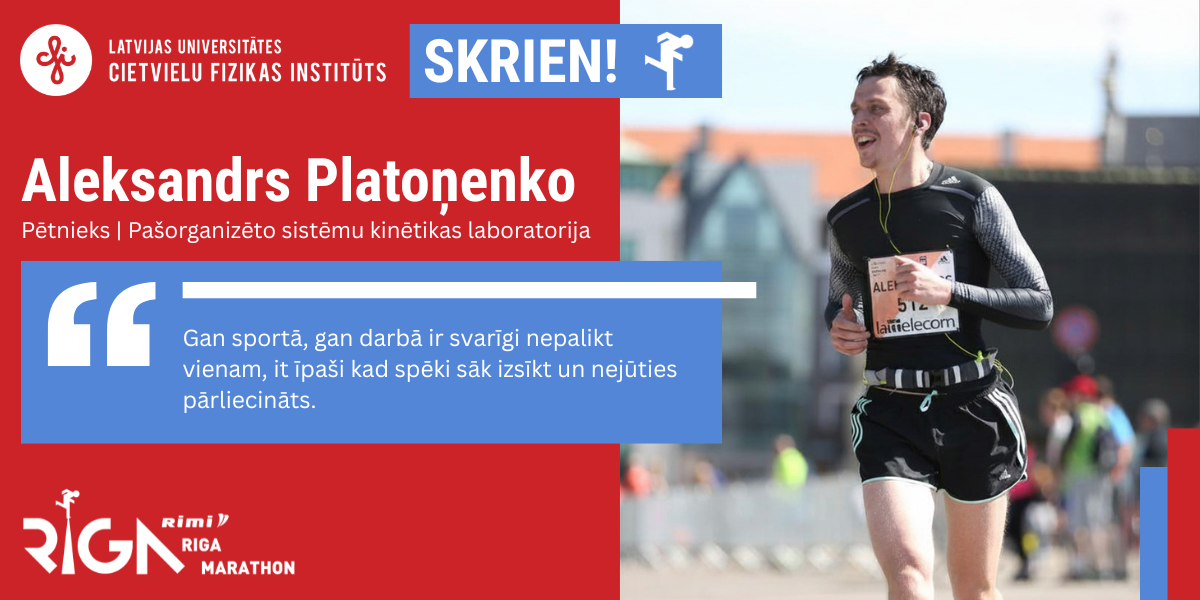
We spoke with Aleksandrs Platoņenko, a researcher at the Laboratory of Kinetics of Self-Organizing Systems, about timely preparation and running on an international scale.
How would you briefly describe your scientific field and what you research?
Computer modeling of materials at the atomic level. I mostly study materials related to light emission and/or those affected by radiation (phosphors, scintillators, functional oxides).
When and why did you start running? How did you transition to marathons and long distances?
I can no longer remember exactly why, but I started running in 2015. I know my first goal was to finish the 10 km distance at the Riga Marathon. After that, I tried a half-marathon in Vilnius, another marathon in Riga in 2016, trail running, and so on. I met other runners with whom we now travel together to run in Italy, Poland, and the Czech Republic. Running became part of the travel process – after all, you wouldn't travel that far just to run 10 km. That’s why long distances seem more interesting.
How much time per week do you dedicate to running? What distances or routes do you usually take?
I try to go out 3–4 times a week – at least one long run (15+ km) and one speed session. Now, in the process of preparing for a marathon, I need to clock about 40+ km per week. I try to find a new route every time; even during a single run, I really dislike running the same route twice.
Do you see parallels between scientific work and marathon preparation? What part of marathon discipline helps most in science?
If you start on time and prepare well, everything will be fine! I realized this when I ran unprepared. The same applies to writing projects, creating presentations, and preparing speeches – start early, write slowly, and keep improving. That is the best way to get these tasks done!
How do you balance training with laboratory work and projects?
I spend about 4.5 hours a week on training, two of which are on weekends. With good planning, it’s not difficult to find the time. Moments of slow running can also be used productively – for example, to evaluate certain results or to let a project idea materialise.
How does running affect your thinking or research productivity? Have you had any "aha moments" while running?
Physical activity really helps the mind rest, so I think the impact is positive. I’ve had new ideas come to me, and I’ve managed to look at existing results from a different perspective, leading to valuable insights.
How do you feel during the last 10 km of a marathon? How do you overcome a “crisis of will” – both in a race and in projects?
When I prepared very well for a race in 2017, the last 10 km were the fastest. Supporters help a lot in overcoming a crisis. However, during a 54 km trail run in Poland in 2019, I had a real crisis of will – I just didn't want to run the last 5 km. But a runner from Poland convinced me with just a few sentences to run together and finish the course. That’s why in both sports and work, it’s important not to stay alone, especially when your strength starts to fade and you don't feel confident.
Does your scientific thinking influence how you train? For example, do you analyze your training data (HR, VO2max, pace) or use specific strategies?
Yes, of course. I like looking at the data after a run, though I realize I can't deduce anything useful from most of it. I have a preparation plan and I stick to it. But I also try to add something new and experiment during training based on how I feel and new information.
Will you be running in any other events this year?
I’ve registered for the UTMB Gauja Trail – 42 km through the forest along the Gauja River. I also want to walk/run the 100 km "ZS" march from Riga to Ērgļi.
Which marathon has stayed in your memory the most and why?
My best marathon was in 2017 with a result of ~2:58. The goal was achieved, and I remember how easy the run felt overall because I had invested so much effort into the preparation process.
What would you recommend to a colleague who wants to start running? How to start if time is very limited?
Well, if you want to, then just run. Either on your own, or – at least in Riga – there are many opportunities to run with others: RigaRunClub, open training sessions for the Riga Marathon. There are usually many beginners there with all the classic problems – no time, never exercised before, afraid to start, etc.
If you listen to music while running, what is your favorite song?
I listen to various music while running; usually, I choose one genre and listen to what YouTube Music or Spotify suggests. That’s how I’ve found many new tracks that have stayed with me for a long time.
What is one book you would recommend to others?
Kittel’s “Introduction to Solid State Physics” (laughs).
What is one habit that changed your life?
Going to bed on time.
Your next goal in science or running?
In running, my goals are three distances this year – that's clear. In science – I want to attract more students to the laboratory's projects.
