
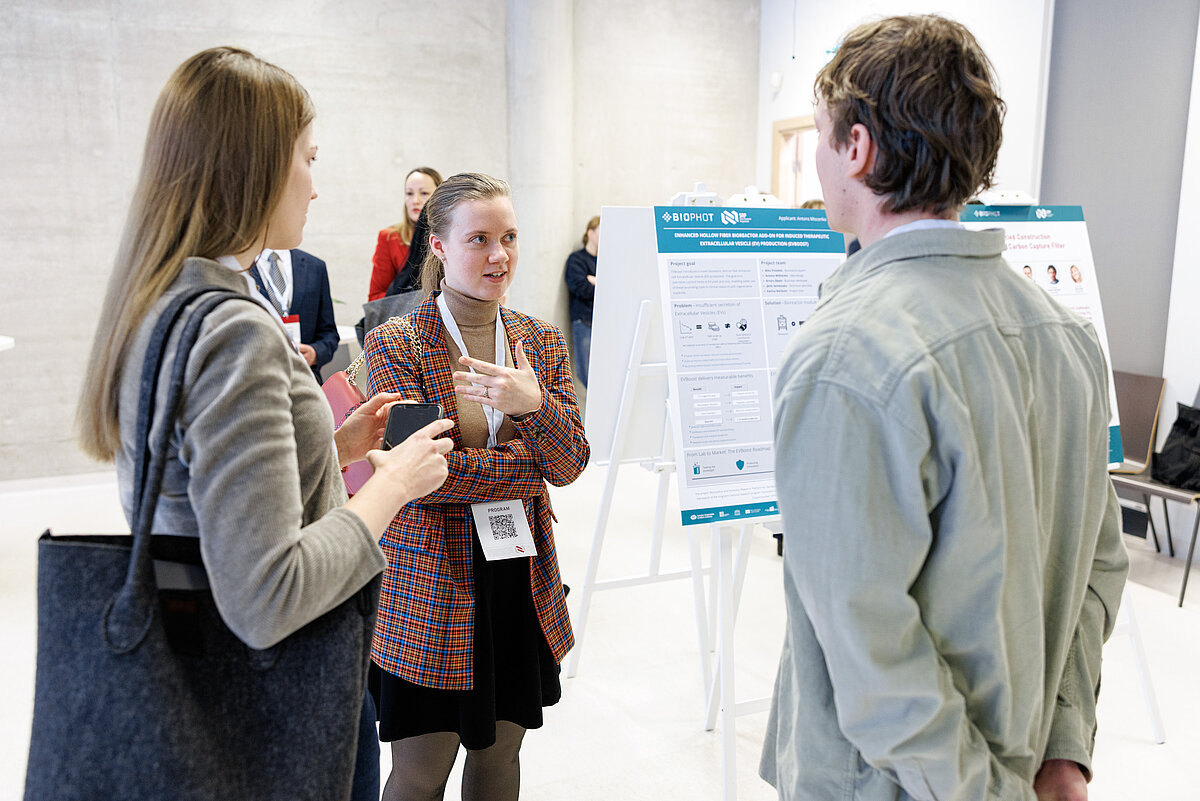
In the second call of the BioPhoT platform, 26 Research and Innovation Projects (RIP) have been awarded funding. The platform’s Project Management group reports the competition was particularly strong – a total of 99 project applications were submitted, and after two evaluation rounds, the most innovative and scientifically high-quality proposals were selected.
A particularly notable achievement is the performance of the Institute of Solid State Physics, University of Latvia (ISSP UL) – seven projects from the institute have secured funding, the highest number among all research institutions in the second call.
In the first evaluation round, projects were assessed by an industry expert panel, focusing on market potential, alignment with user needs, and commercialisation prospects. In the second round, scientific quality was evaluated by experts of the Latvian Council of Science.
ISSP UL research teams will implement the following projects:
- ARPEX – aberration-free ruggedized polarizing optics for an extended reality headset
- DARS – direct-write afterglow on standard road signs
- MARLIN – maritime adaptive IR-laser-based underwater intercommunications
- POLYMONIA – polymer-based ammonia sensor
- EpiClean – in-situ ellipsometry-guided wet cleaning to achieve imaging-grade gaas
- CLOTcheck – point-of-care device for blood clotting assessment
- Molecular catalyst design to electrolyzer assembly for electrocatalytic conversion of CO₂ to formic acid
Within the second call, a total of €4,710,859 will be invested in project implementation. Each project will receive up to €190,000 for eight months of research and innovation activities.
The aim of the BioPhoT platform is to develop high value-added technologies in biomedicine, medical technologies, pharmaceuticals, photonics, and smart materials, reducing the gap between fundamental research and the commercial sector. Since the platform’s launch, a total of 223 project applications have been submitted across two calls, demonstrating strong researcher interest. 40 projects were supported in the first call.
