
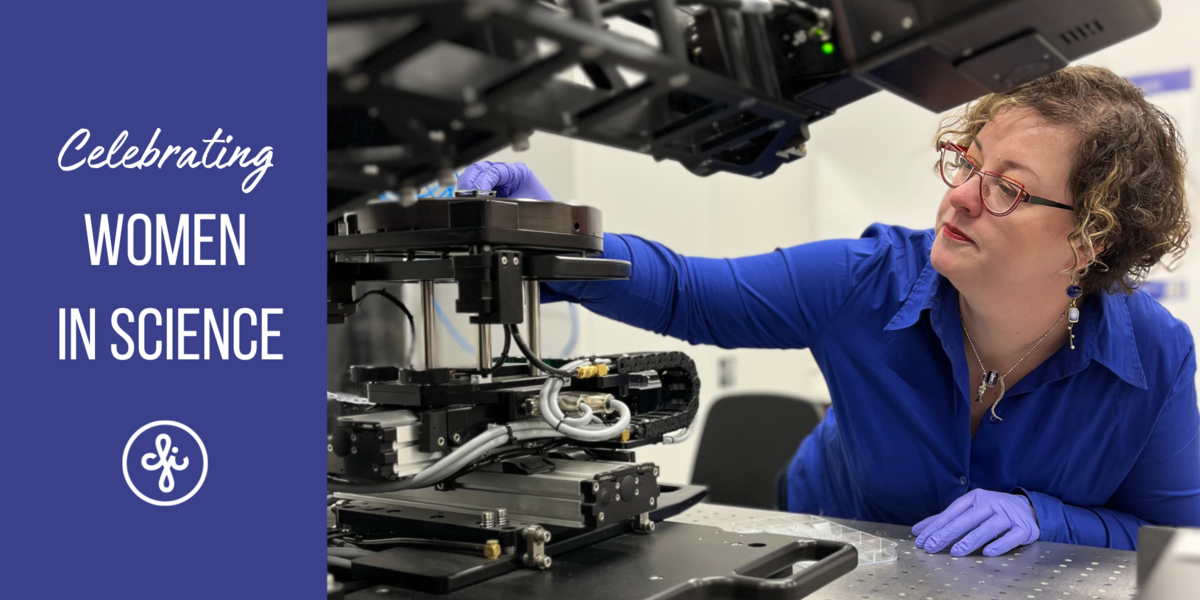
11 February is the International Day of Women and Girls in Science – a day that highlights how essential equal opportunities are for science to continue its vital progress. At the Institute of Solid State Physics, University of Latvia (ISSP UL), we are fortunate to work with women who inspire and drive innovation in photonics, nanotechnology, and various fields of materials science.
To mark this occasion, we invited one of our outstanding researchers – Jeļena Butikova, Leading Researcher at the Laboratory of Spectroscopy – for an interview to share her career path and what it means to be a woman in science.
How would you explain your work to someone who is not connected to science?
This is actually the hardest question. From the outside, a scientist’s job looks like this – a person sits and stares at a computer, and curses. (laughs) But explain our work in short, what we do is read scientific papers to see what others have done, identify what they haven’t done, and then do it ourselves. In my case, this also includes experimental work and calculations, but a large part is reading scientific literature, analysing it, and trying to come up with something new.
As for my scientific field, I work in spectroscopy – more specifically, laser ablation spectroscopy. With a laser pulse, we “break off” a very small particle from a material sample, creating plasma. We then examine its light using a spectrometer, which allows us to identify what elements are present in the sample, their concentration, and more. I also work with spectroscopic ellipsometry, where we shine polarised light from a xenon lamp onto a material. The reflected light is captured by a sensor – this way, we can precisely determine the thickness of thin films or sets of thin layers.
What motivated you to choose science as a career?
Actually, I originally planned to start studying Japanese philology at the University of Latvia, but admissions there only took place every second year – and it just so happened that when I finished school, admissions were not open. But at school I had studied in a physics and mathematics class, and those subjects came easily to me. So I decided to wait and “sit out” one year by studying physics – and that was it! I liked it! (laughs)
My interest in spectroscopy started already in my first or second year – I was fascinated by spectral line databases on glass plates, which were placed under a light source to project the lines. I was already working at ISSP UL while writing my bachelor’s thesis, but I returned here later, after working in a holography laboratory and having just defended my master’s thesis. While thinking about what to do next, I heard that doctoral students were being sought to support the development of nuclear fusion reactors.
I have a personality where it truly doesn’t matter what lies ahead – so by finding the key people and clearly explaining the direction I wanted to pursue, I ended up at the institute. And after defending my doctoral thesis, there was no reason to go anywhere else – so here I am.
What gives you satisfaction in your work?
I am very happy to be involved in work that genuinely contributes to the future, for example through the EUROFusion project. One might think Latvia’s role there is small, but when all the small contributions are brought together, something truly important emerges. And even if you do one small part, you can see how it helps move everything forward.
It is also a great pleasure to work with colleagues abroad – they are all very pleasant people. With some of them, we have been collaborating since our student years.
What challenges do women in science face today?
Being a woman in general is difficult! (laughs) Recently, I received an invitation to fill out a survey specifically for women in science – about impostor syndrome and burnout. I cannot speak for everyone, but I do experience this from time to time. I don’t know why, but I truly hope younger colleagues no longer feel this way.
At school we were a close-knit class, and at university I cannot complain about attitude-related issues, but outside of that, this feeling – “ugh, these girls” – has been in the air. What I can say is that all the remarks and negative comments happened face to face; clearly, it is never public. I truly hope that over time we are moving away from that. Without a doubt, the right attitude has to start already in school, because teachers are the people who influence children the most.
What advice would you give to girls who are interested in science?
The fact that something is difficult must not stop you. Because everything is difficult! (laughs) Any topic you explore deeply requires mental effort. Yes, perhaps a certain personality is needed, but that applies not only to girls.
So if you are truly interested and someone tells you it is “not for girls” – just ignore them. It is genuinely great when something truly excites you.
What would you change in academia and the scientific world overall?
Of course – I would really like to change the science funding model. (laughs) I would like obtaining funding in Latvia to be more scientist-friendly. Another issue is speed. Science, especially fundamental science, cannot immediately offer a “finished product” – serious discoveries require time and several stages of trial and error at different levels.
Nowadays, the emphasis is often placed on safe results and predictable outcomes. But if you already know how a project will end while writing it, why start it at all? Scientists are forced to survive by moving from one three-year project to the next, but high-risk, high-reward ideas simply cannot mature within a single grant cycle.
So, just like we talk about “slow eating,” it might be time to return to “slow science.”
How do you rest and recharge outside of work?
I don’t know if it truly recharges me, but I have a side hobby – translation. I specialise specifically in medical texts. If we're talking about maintaining health, I enjoy swimming, and when I have time and inspiration, I visit the pool.
What should society better understand about scientists?
Scientists are just ordinary people. Although this is a fading trend, some may still think researchers are somehow “above” everyone else, or that science is an extremely creative job. But when you have to clear goods through customs… (laughs) Poof goes the creativity!
Even during my PhD studies, I had a completely wrong impression of what science is – I thought I would simply sit in a laboratory, but there are also many practical and administrative details involved. You need to know how to speak in front of an audience! So science is not something distant or incomprehensible – it often includes duties that any other person would deal with in everyday life.
