
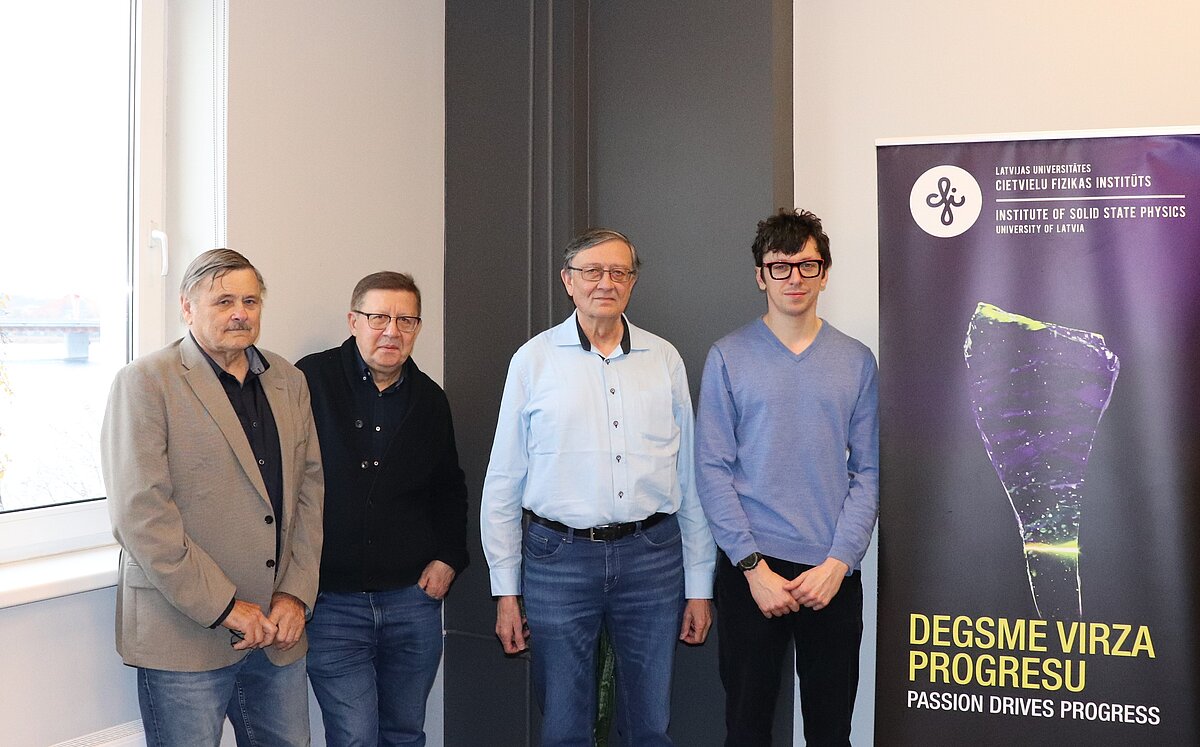
At the Institute of Solid State Physics, University of Latvia (ISSP UL), international collaboration is an everyday reality. Our labs regularly welcome visiting scientists from around the world – some arrive to share knowledge in guest lectures, others to develop joint projects or use our advanced research infrastructure to push their studies further. Recently, one such visitor was Dr. Theo Scherer, a professor at the Karlsruhe Institute of Technology, whose expertise lies in plasma physics and nuclear fusion. We sat down with him to learn more about his work and long-standing collaboration with ISSP UL scientists.
I come from the Karlsruhe Institute of Technology where I’m a professor for Electrotechnics & Informatic Technology and for Physics. My field of expertise is plasma physics and nuclear fusion – corresponding with that, I also work in the fields of diagnostics, sensor technology and others. For example, I’ve worked with Astrophysics in Cambridge for the Smithsonian institute where I developed detectors for the electromagnetic spectrum (ranging from 700 MHz up to 1THz). In that time, I also applied myself to superconducting detectors to observe objects in space, and now we use the same technology for diagnostics in nuclear fusion plasma machines.
Our institute is very involved in the ITER project – for example, we are responsible for diagnostics as well as the heating systems for the electron cyclotrons. In collaboration with industry, we developed diamond windows and diamond technology to transmit high-power microwaves (frequencies from 140 up to 240 GHz) into a machine to heat up and stabilise the plasma. Diamond is a very noble material, the only one that can withstand this high-power transmission without evaporating. It’s a very important job, and our lab is responsible for the characterisation and qualification of all diamond torus discs and gyrotron discs that will be implemented in ITER. Additionally, our lab engages in basic research of solid state physics to understand diamond and defects in it. That way we can gauge how these defects influence the material’s dielectric properties that determine conductivity. We also study the mechanical properties that are important for the safety of nuclear fusion reactors.
In optimising the use of these and other functional materials that could be implemented in future reactors, we have a close collaboration with ISSP UL for several years now, namely with the leadership of Dr. phys. Anatoly Popov. We’ve already worked together on 3 projects with one concluding this year, and we’re looking to start a new one in connection to metallic oxides, high-entropy alloys – important for structural materials in nuclear fusion reactors. The project has already been accepted so we’ll be starting soon. As for Karlsruhe, we’ll be continuing our work on qualifying diamonds windows for ITER, as well as launcher development for the antennas of the heating systems used for the DEMO reactor, the planned next step of ITER.
