
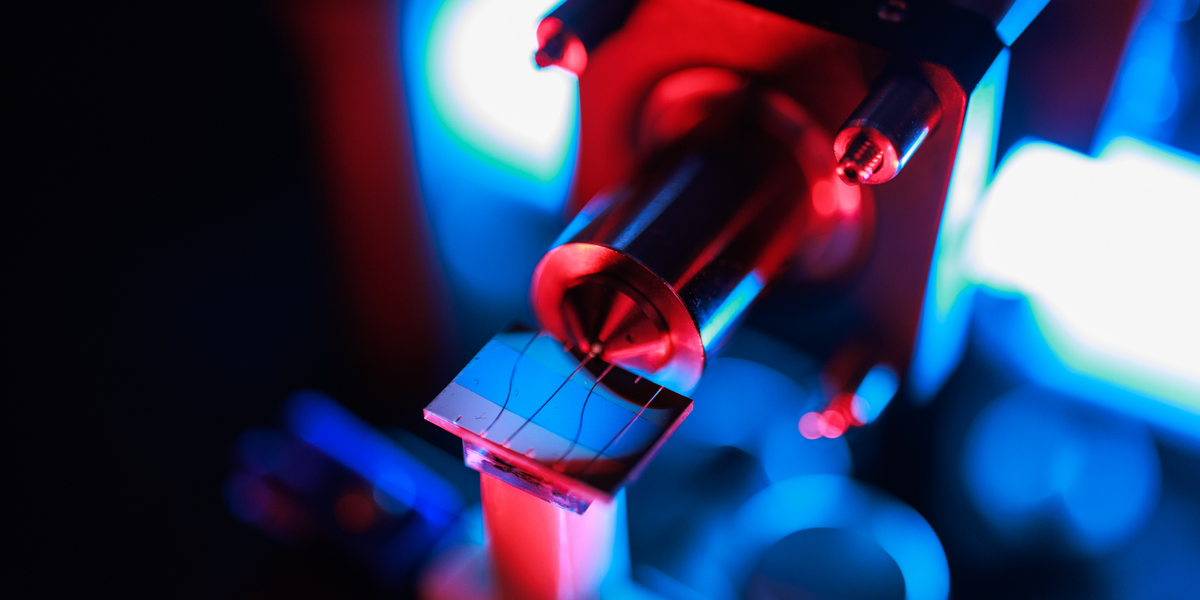
A new Latvian deep-tech company, AP4PIC, has emerged from long-term research carried out at the Institute of Solid State Physics, University of Latvia (ISSP UL). The company is developing polymer integrated photonic chips – next-generation microchips that use light instead of electrical signals for data processing and transmission. This technology has the potential to significantly reduce energy consumption in data centres and high-performance computing systems worldwide.
The foundation of AP4PIC lies in many years of ISSP UL research into the optical and functional properties of polymers and their applications in photonics. As this research advanced and demonstrated strong commercial potential, a spin-off company was established in 2024. Today, AP4PIC continues developing the first prototypes of polymer photonic ICs in collaboration with Riga Technical University.
Integrated photonics is rapidly becoming one of the most promising directions in global deep tech, and AP4PIC is currently the only company in Latvia working in this field. Unlike most international players who focus on silicon-based solutions, AP4PIC leverages organic polymer materials, enabling greater design flexibility, broader functionality, and compatibility with diverse sensing and communication systems. This opens opportunities not only for data centres but also for advanced optical sensors used in biomedicine, environmental monitoring, and industrial diagnostics.
“It’s estimated that in the near future operating AI could take up towards 10% of worldwide energy consumption – if our technology can decrease this consumption by just a few percent, the benefit on a global scale can be massive,” notes Aivars Vembris of AP4PIC who is also the Head of the Organic Materials Laboratory at ISSP UL.
AP4PIC aims to deliver market-ready solutions in the coming years and position itself as a regional leader in polymer integrated photonics – demonstrating once again that cutting-edge technologies developed in Latvia can contribute meaningfully to the global shift toward more energy-efficient and sustainable computing.
